The Personal Diary Before the Goal-Setting Era
The personal diary before the goal-setting era could record plans, events and private reflection together. Learn how to read its pages without treating them as rules.
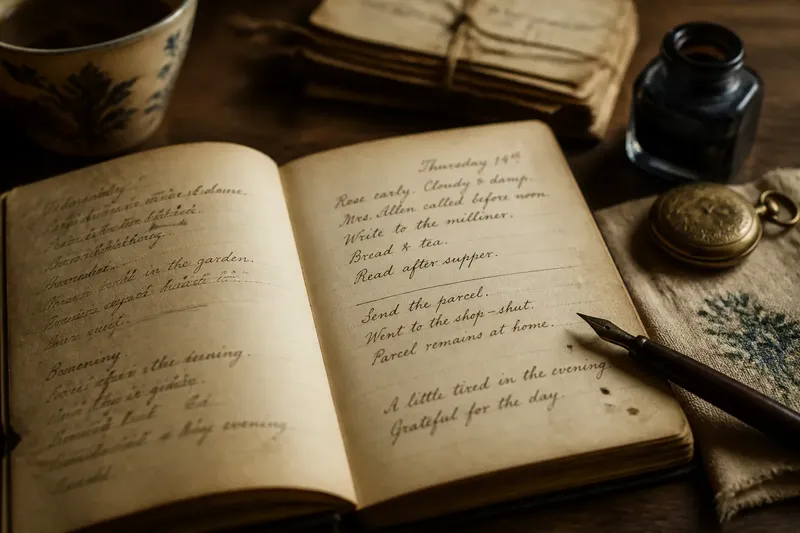
The personal diary before the goal-setting era was not one fixed format. A surviving page might hold a reminder, a visit, a feeling or a household note, but its contents depended on its writer and purpose. Read each entry in context rather than treating historical diaries as a single tradition.
The personal diary before the goal-setting era had varied purposes
There is no single point at which diaries began to resemble modern goal-setting tools. Diaries from different periods and settings served different purposes: some recorded daily events, while others included practical reminders, personal reflection or spiritual examination. Without a defined period or a particular collection of diaries, broad claims about what diarists generally did are difficult to support.
A page that combines an errand with a passing thought does not, by itself, reveal a standard format. It shows what one writer put on that page. To understand the entry, look at its date, surrounding notes, recurring subjects and any clues about the intended reader.
Keep the historical claim narrow: describe the page you can see, not an entire era you have not defined.
Read plans alongside the circumstances around them
A note such as “write to the milliner” records an intention, but it also shows what occupied the writer’s attention. A weather note or mention of a visitor may help explain the day without turning the page into a modern system of targets and reviews.
For a present-day reader, the useful distinction is between a plan and its context. “Errand postponed” tells little on its own; a nearby note about a closed shop may explain the change. In a diary you keep, adding a brief reason can make an entry easier to understand later.
Describe what happened before judging what it says about the person.
A diary entry does not always mean a modern goal
Writers could note duties, plans or resolutions without using the frameworks people now associate with goal-setting. A line such as “read after supper” may be a reminder, an intention or part of a broader record. The words around it offer better evidence of its purpose than a modern label imposed afterwards.
Imagine a fictional diarist who writes “send the parcel”, then records that the shop was shut and the parcel remains at home. The entry links an intention to an obstacle and an outcome. It does not show that the writer used a formal goal system; it shows what that writer chose to record.
When an entry is brief, leave its purpose uncertain unless the surrounding pages clarify it.
Audience and privacy shape what appears on the page
A diary may have been private, intended for family, or written with the possibility that someone else would read it. The intended audience can affect what a writer records and how directly they express a thought. “Personal” does not necessarily mean written for an isolated reader.
When examining a diary, ask whether its contents suggest a reminder, a running account, a household record, a place for self-examination or a mixture. Treat these as questions to test against the page, not categories to assign automatically.
Before interpreting a candid sentence, check for clues about who might have been expected to read it.
What can readers learn from historical diary pages?
Were diaries always private?
No single answer fits every diary. Some were written for personal use, while others may have been shared, preserved for relatives or used as records; look for evidence about audience in the diary’s context.
Did diarists set goals in the modern sense?
Some entries record plans, duties or resolutions, but that does not make them equivalent to a contemporary goal-setting system. Read the wording and neighbouring notes before assigning a purpose.
Why include ordinary details?
Notes about errands, visits or weather can record daily events and provide context for later recollection. Their presence does not necessarily signal a deliberate method of self-improvement.
Can old diaries suggest a format for keeping one now?
They can prompt options, such as recording a plan alongside the circumstances around it. They cannot determine which format or level of privacy suits a particular person.
Borrow a writing practice without borrowing a historical claim
- Check for mixed entries. If a page places an errand beside a feeling, describe both before deciding what the combination means; if the context is unclear, keep the interpretation open.
- Check for reasons a plan changed. If the entry names an obstacle, include it in your reading; if no reason appears, do not invent one.
- Check the difference between event and judgement. If a writer records an unanswered letter, separate that event from any claim about character; if the page makes no such claim, do not add one.
- Check for signs of an intended reader. If the diary addresses or refers to another person, consider a shared audience; if there is no clue, leave privacy uncertain.
- Check whether the same subject recurs. If several entries return to it, note the pattern; if it appears once, avoid calling it a lasting concern.
- Check how much the page actually tells you. If dates and surrounding entries clarify a note, use that context; if they do not, state what remains unknown.
These are reading choices, not rules for keeping a diary. A calendar, voice note or loose page can also preserve an intention and the circumstances around it.
Let the page set the limits of your interpretation
The personal diary before the goal-setting era is best approached as a varied kind of record, not a single historical practice. One writer’s page may join a plan to a daily event; another may focus on household business or reflection. The entry itself, rather than an assumption about an era, should guide what you say.
If you keep a diary, try noting a plan and what affected it, then decide whether that context helps you understand the day. If you read a historical one, use its dates, recurring subjects and audience clues to support your interpretation. Where those clues run out, leave the question open.